
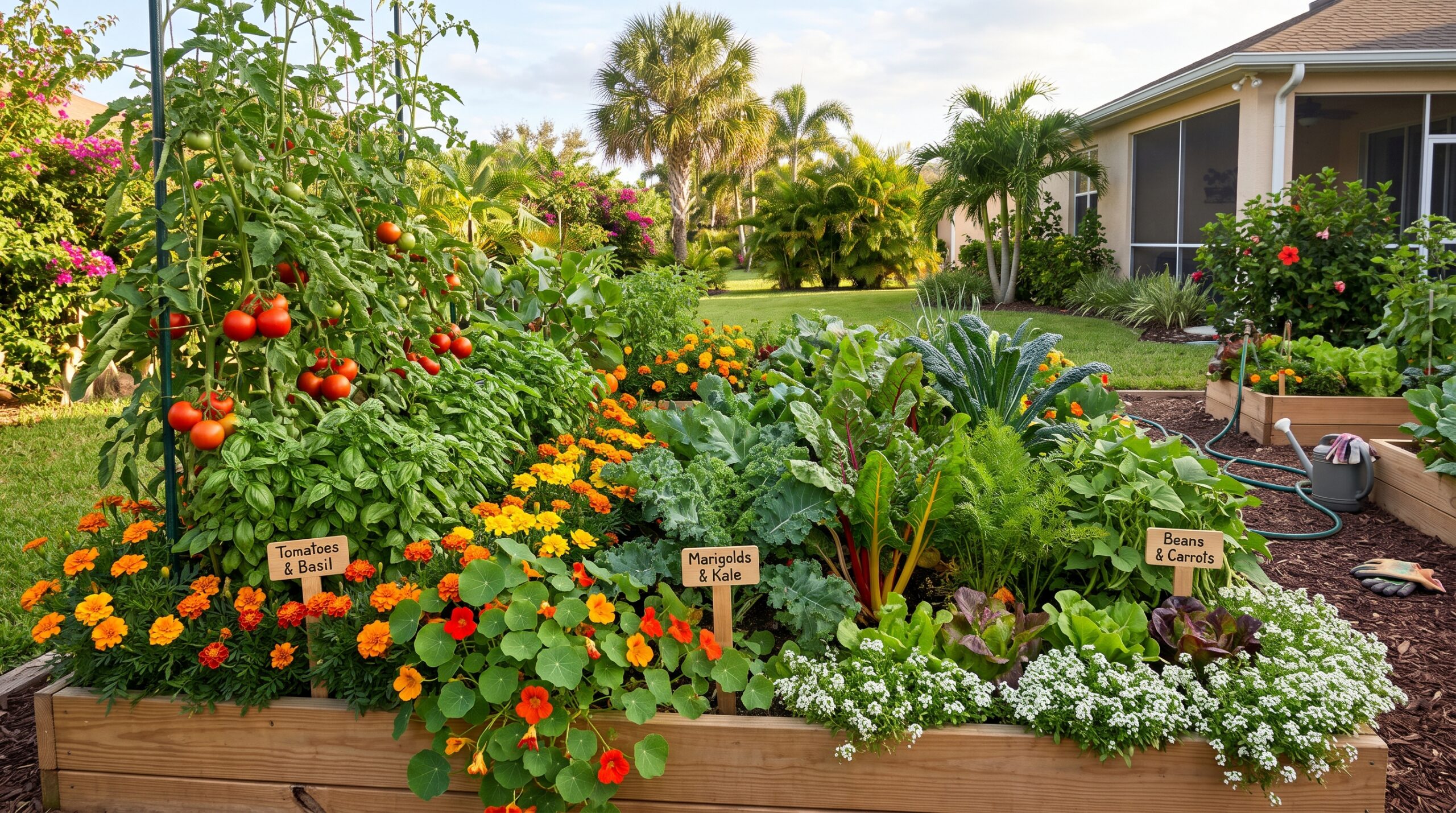
Companion planting in South Florida works best when vegetables, herbs, and flowers are grouped according to compatible growing conditions rather than rigid planting charts. In Palm Beach County, successful combinations need to account for seasonal temperatures, sunlight, water needs, mature plant size, and airflow.
For example, taller tomatoes can share space with lower-growing plants, while cucumbers can be trained vertically to leave more room for compact crops. The goal is simple: combine plants that can grow successfully together without unnecessary competition.
What Is Companion Planting?
Companion planting is the intentional placement of different plants near one another. It is often promoted through lists claiming that certain combinations repel pests or make neighboring plants grow better. Not every popular claim has strong scientific support.
For a South Florida kitchen garden, the more dependable strategy is to focus on practical compatibility. Plants that prefer similar conditions and occupy different levels of garden space can often share a bed successfully.
The UF/IFAS Florida Vegetable Gardening Guide provides Florida-specific information about vegetable selection, planting periods, spacing, and growing conditions.
What Can You Plant Together in South Florida?
Good combinations depend partly on the season. Instead of memorizing a universal list, consider how each plant will behave as it matures.
Tomatoes With Lower-Growing Plants
Tomatoes grow vertically and can become substantial plants. Lower-growing herbs or seasonal leafy crops may fit nearby when both plants are suited to the same growing period.
Leave enough room around tomatoes for airflow and harvesting. South Florida humidity makes overcrowding particularly undesirable, so companion planting should not become an excuse to fill every open space.
Peppers With Compact Herbs or Greens
Peppers can work well beside smaller plants that will not shade or overwhelm them. Compact herbs or appropriate seasonal greens may use nearby space efficiently while keeping the pepper plants accessible.
Timing matters. Some leafy crops favor cooler South Florida conditions, while established peppers can tolerate warmer periods. A combination only makes sense when both plants can perform during the same part of the local growing season.
Cucumbers With Smaller Crops
Cucumbers can quickly occupy a large portion of a garden bed if their vines are allowed to spread. Training suitable varieties on a trellis can preserve ground-level space for smaller crops.
Position the trellis so mature vines do not block important sunlight from neighboring plants. This is a practical example of using growth habits to decide what belongs together.
Flowers Alongside Vegetables
Flowers can add visual interest and plant diversity to an edible garden. They may also provide resources for visiting pollinators and beneficial insects.
Place flowers along bed edges or in planned sections where they will not restrict harvesting or crowd food crops. More detailed pollinator planning should consider bloom timing and the specific insects you want to support.
How Do You Choose Compatible Companion Plants?
Before putting two plants together, compare their basic needs and growth habits.
Ask:
- Are both suited to the same South Florida growing season?
- Do they need similar amounts of sunlight?
- Are their irrigation needs compatible?
- How large will each plant become?
- Will one shade the other at maturity?
- Is there enough airflow between them?
- Can both plants be reached easily for harvesting?
A thoughtfully designed Kitchen Garden can use compatible combinations while preserving the spacing, pathways, and access needed to keep the garden functional.
What Companion Planting Mistakes Should You Avoid?
Companion planting becomes less useful when gardeners focus on plant pairings while ignoring basic growing requirements.
Overcrowding Young Plants
New transplants leave visible gaps, but those spaces disappear as plants mature. Filling every gap can eventually create dense foliage, restricted access, and poor airflow.
Plan for mature plant dimensions rather than how empty a bed looks immediately after planting.
Following a Planting Chart Without Considering Florida
Many companion-planting charts are written for climates with very different seasons. Two plants may be described as good companions but still perform poorly together if their ideal growing periods do not overlap in South Florida.
Use local planting recommendations first and companion relationships second.
Expecting Companion Plants to Control Every Pest
Plant diversity can contribute to a balanced garden, but neighboring plants should not be treated as guaranteed pest protection. Continue inspecting leaves, stems, and produce so actual problems can be identified early.
Palm Beach Kitchen Gardens plans edible gardens around South Florida conditions, including seasonal timing, plant selection, spacing, and practical access.
Frequently Asked Questions
What vegetables grow well together in South Florida?
Vegetables can share beds successfully when their season, sunlight, water, spacing, and growth requirements are compatible. Tomatoes with appropriately spaced lower-growing plants and trellised cucumbers near compact crops are practical examples.
Does companion planting really work?
Yes, when companion planting is used as a practical design strategy. Combining plants with compatible needs and complementary growth habits can help use garden space efficiently. Specific claims about pest repellence or enhanced growth should be evaluated individually.
Can I plant herbs and flowers with vegetables?
Yes. Herbs and flowers can be incorporated into vegetable beds when they are appropriate for the season and do not compete excessively for light, water, or space.
Plan a Better South Florida Kitchen Garden
Successful companion planting is less about memorizing “good” and “bad” pairs and more about understanding how plants share space. Matching crops by season, mature size, sunlight, irrigation needs, and growth habit creates a stronger foundation for a productive garden.
If you want a kitchen garden planned around compatible plants in Jupiter or elsewhere in Palm Beach County, contact Palm Beach Kitchen Gardens to discuss a practical edible garden designed for your property.
Meta Title: Companion Planting South Florida Kitchen Garden Guide
Meta Description: Learn companion planting in South Florida with practical plant pairings, spacing tips, seasonal guidance, and ideas for a more productive kitchen garden.